 English
 简体中文
简体中文
 Deutsch

Russell Chedgy, PhD
Application Scientist at Picarro
Picarro Spotlight is a blog series showcasing important scientific work from our customers around the world. Each blog is selected and summarized by our team. Enjoy!
The Arctic Ocean is freshening fast — but where that freshwater comes from, how it mixes, and where it goes next are surprisingly hard questions to answer.
Two new companion studies help change that.
Together, Dr. Jie Huang and Dr. Bob Pickart of Woods Hole Oceanographic Institution, Dr. Ben Kopec of the Great Lakes Research Center, Michigan Technological University and UArctic Research Chair, Professor Jeff Welker of the Universities of Alaska Anchorage and Oulu Finland and colleagues, show how high-resolution hydrography and seawater isotopes can reveal the full story of Arctic freshwater pathways — from coastal Alaska all the way to Baffin Bay and the Labrador Sea.
From a Single Basin to a Pan-Arctic View
In Water Mass Evolution and General Circulation of Baffin Bay: Observations from two shipboard surveys in 2021, Huang, Pickart, Kopec, & Welker et al. use data from two late-summer 2021 shipboard surveys (USCGC Healy and CCGS Amundsen) to give Baffin Bay one of its clearest oceanographic portraits to date.
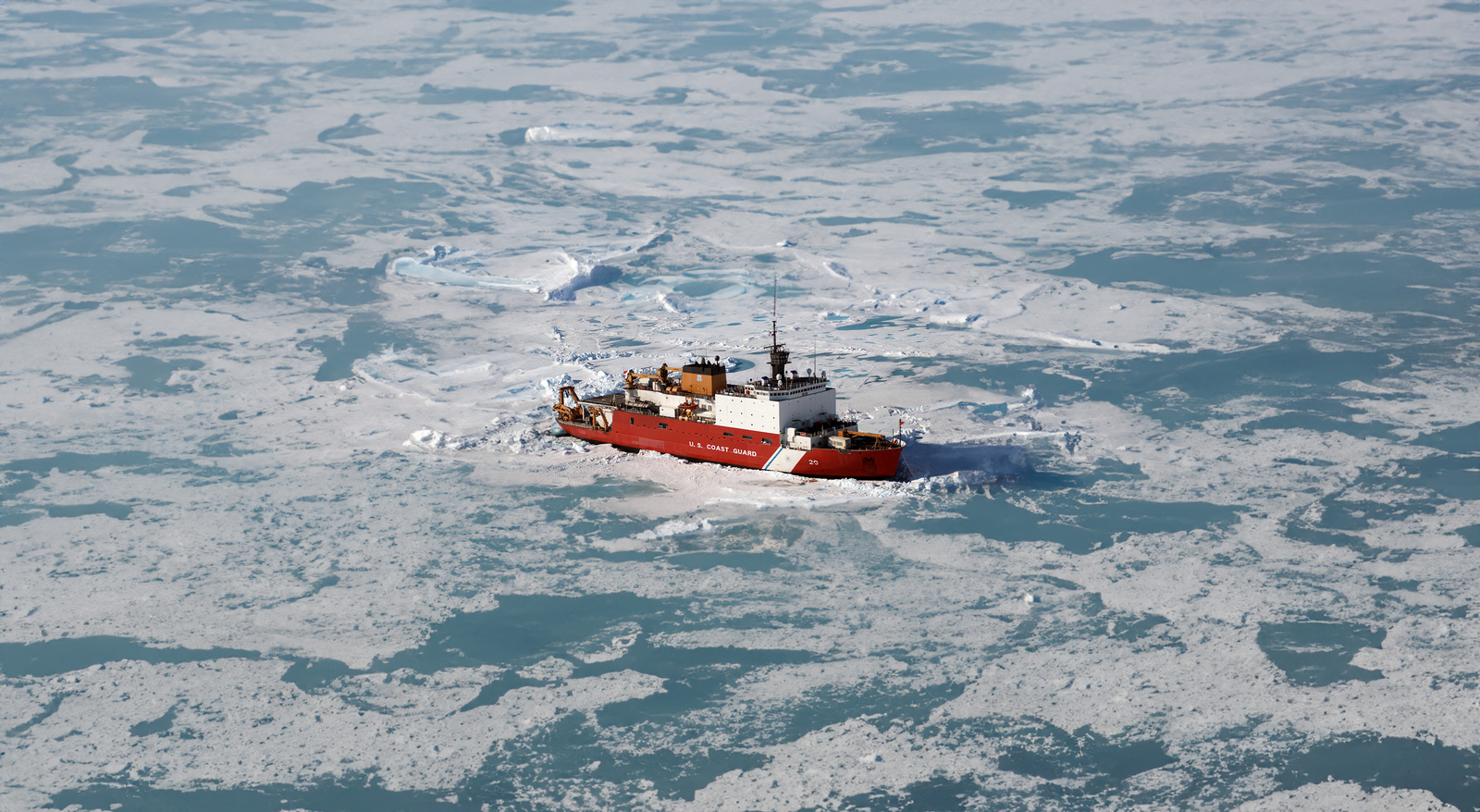
USCGC Healy
They combined:
- High-resolution temperature and salinity profiles
- Nutrients
- Oxygen isotopes (δ¹⁸O, δ²H) measured with a Picarro L2130-i Isotope Analyzer
- Direct velocity measurements and reanalysis fields
- The picture that emerges is striking:
- The upper 300 m of Baffin Bay are dominated by cold, fresh, nitrate-depleted Polar Water, especially along the western Baffin Island margin.
- Only a small amount of warm, salty Atlantic-origin water reaches the basin at depth and is quickly diluted.
- The basin is organized by a strong cyclonic (counterclockwise) circulation, with a fast western boundary current, a weaker eastern boundary current, and recirculating Polar Water in the interior.
These results confirm Baffin Bay as a critical Arctic-to-Atlantic gateway — one that is currently much fresher and more Polar-dominated than many models assume.
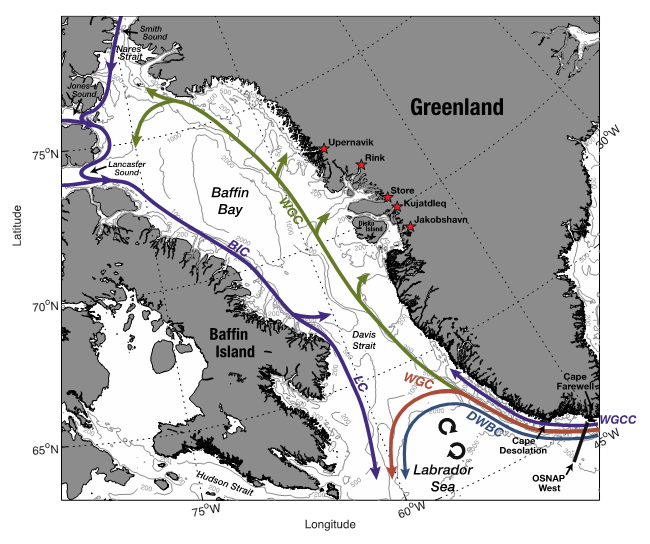
Schematic circulation in Baffin Bay and the northern Labrador Sea
Freshwater Fingerprints Across the Arctic
In Arctic Freshwater Sources and Ocean Mixing Relationships Revealed With Seawater Isotopic Tracing, Kopec, Welker and colleagues zoom out to the whole 2021 USCGC Healy transect throughout the Northwest Passage, from coastal Alaska through the Canadian High Arctic, across Baffin Bay, and into the Labrador Sea.
Using continuous surface seawater isotope measurements (δ¹⁸O, δ2H and deuterium excess) alongside traditional temperature–salinity data, they:
- Partition freshwater sources (meteoric water, glacial melt, river input, sea-ice melt, and ocean water) along the entire route.
- Show that Western Arctic freshwater is dominated by meteoric inputs, especially the Mackenzie River, with a smaller sea-ice melt component.
- Reveal that in Baffin Bay, freshwater is primarily from local precipitation and glacial meltwater, with sea-ice melt playing only a minor role during the survey period.
Crucially, they demonstrate that this level of source separation cannot be achieved with temperature and salinity alone — you need isotopes to see which freshwater is doing what, and where.
What We Learn When We Put It Together
Viewed together, these two studies tell a powerful, connected story:
- Huang, Pickart, Kopec, & Welker et al. show that Baffin Bay’s upper ocean is overwhelmingly Polar and fresh, organized by a robust cyclonic circulation that helps retain and recirculate that freshwater within the basin.
- Kopec & Welker et al. show that the composition of that freshwater is changing, with Baffin Bay increasingly influenced by local precipitation and glacial melt, while the Western Arctic is shaped by large river systems like the Mackenzie.
Together, they highlight:
- How freshwater builds up across the Arctic and is routed through gateways like Baffin Bay.
- How fjord and shelf processes, glacier melt, and large rivers feed into basin-scale circulation and eventually the subpolar North Atlantic.
- The central role of seawater isotopes — measured with high-precision analyzers like the Picarro L2130-i — in separating these freshwater sources and quantifying their mixing relationships.
For scientists and modelers, this combined view provides better constraints on who contributes freshwater, where, and how that water moves, all of which are essential for improving projections of Arctic change, Labrador Sea freshening, and potential impacts on the Atlantic Meridional Overturning Circulation.
A Global Collaborative Effort
These insights come from two closely linked, multinational teams working from ship to shore.
Baffin Bay circulation and water masses (Progress in Oceanography):
Jie Huang, Robert S. Pickart, Frank Bahr, Leah T. McRaven, Jean-Éric Tremblay, Christine Michel, Emil Jeansson, Ben G. Kopec, Jeffrey M. Welker, and Sólveig R. Ólafsdóttir.
Arctic freshwater sources and mixing (JGR Oceans):
Ben G. Kopec, Eric S. Klein, Gene C. Feldman, Shawn A. Pedron, Hannah Bailey, Douglas Causey, Alun Hubbard, Hannu Marttila, and Jeffrey M. Welker.
From Woods Hole to Michigan Tech, Alaska to Oulu, Finland and Tromsø, Norway these researchers brought together shipboard observations, isotopic tracing, and advanced analysis to map how Arctic freshwater sources and ocean circulation are evolving in real time.
For More Information
Read Huang et al. in Progress in Oceanography
Read Kopec et al. in JGR: Oceans
Explore Research Center
Learn more about Picarro isotope analyzers