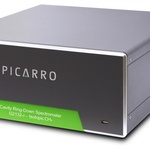
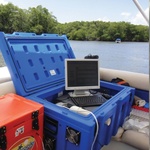
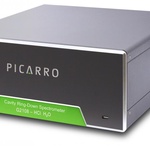
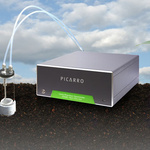
This white paper describes destruction efficiency testing run by Carus and Picarro, Inc. on Carus’s CARULITE® 500 catalyst media using Picarro’s Ethylene Oxide (EtO) Cavity Ring-Down Spectrometer (CRDS) technology. Picarro’s technology provides industry-leading sensitive, accurate, and…
Describes the flexibility of Picarro's fast water isotope analyzer for applications requiring very short sample-to-sample measurement times and shows data taken in lab and field measurements.
Describes recent developments in CRDS instrumentation in the mid-infrared spectral region for applications using N2O isotopologue and trace concentration measurements.
Describes field work conducted with Picarro water isotope analyzer for both water vapor and liquid water samples.
Describes use and methods for stable isotope-based food adulteration testing using Cavity Ring-Down Spectrometry.
Describes application and function of a the LIAISON, a new Picarro universal interface for high throughput analysis.
Describes a field campaign wherein a Picarro water isotope analyzer was used to measure isotopes in water vapor over a corn field in China for the purpose of studying evapotranspiration. The Picarro sampled vapor along with a cold trap sampling system and the real-time Picarro data was compared to offline analysis of the trapped vapor.
The regulation of Earth’s climate and its ability to sustain life are critically linked to water as it exists in all three of its phases (gas, liquid, and solid). Earth’s water cycle, its movement between the hydrosphere, biosphere, and the atmosphere, and how it undergoes phase changes, is incredibly complex. While we continue to gain insight into the water cycle, there remains…
Cavity Ring-Down spectroscopy is becoming a gold standard for atmospheric monitoring. High sensitivity and precision coupled with low drift characteristics ensure optimal operation even in remote field stations or on aircraft and ships. However, current platforms have been limited to two or three species simultaneous observation. Research and development at Picarro have been focused on…
Hydrothermal fluids from two vent sites along the East Scotia Ridge, E2 and E9, were analyzed for their hydrogen and oxygen isotopic values using a Picarro L1115-i CRDS. The fluids display varying salinity, sulfate and hydrogen sulfide content. None of the samples analyzed in this work showed any signs of spectroscopic interference. Isotopic values of the fluids were combined with…
The world’s first continuous flow isotopic TIC/DOC-CRDS measurements are reported here with remarkable achieved precisions. A measurement precision of the isotopic ratio in the range of 0.2 ‰ to 0.4 ‰ was achieved in minutes of measurement time. Such precision readily distinguishes the isotopic DIC and DOC signatures from a set of three different streamwater samples collected from various…
The recent development of a field deployable water isotope analyzer using CRDS technology was used to directly measure the vapor isotopes in real time and at multiple heights above the crop canopy. This technique was coupled with additional samples gathered using conventional techniques and a new xylem water extracting apparatus developed by the IAEA.
In a paper published by the Integrated Carbon Observation System (ICOS), the drift performance of 47 Picarro analyzers of 3 different generations were compared (Yver Kowket al, Atmos. Meas. Tech. Discuss., 8, 4219–4272, 2015). The results show that methane drift (the minimum of the Allan standard deviation) was much better in first-generation G1000 analyzers.
…High-salinity waters such as Seawater poses an operational and maintenance challenge to the measurements of water stable isotopes via Cavity Ring-Down Spectroscopy. As liquid samples are evaporated in the vaporizer peripheral before being sent to the CRDS analyzer, salt precipitates accumulate in the vaporizer chamber. As a result, the sample-to-sample memory performance degrades over time…
Soil flux chamber measurements are a key tool for determining production and sequestration of direct and indirect greenhouse gases. The Picarro G2508 Cavity Ring-down Spectrometer radically simplifies soil flux analyses by providing simultaneous measurements of five gases: CO2, CH4, N2O, NH3, and H2O, and by ready field deployment. The Picarro Soil Flux Software (SFP) …
With a global warming potential of nearly 300, N2O is a critically important greenhouse gas, contributing about 5 % of the US total GHG emissions. Agriculture soil management practices are the dominant source of anthropogenic N2O emissions, contributing nearly 75 % of US N2O emissions. In urban areas, vehicle tailpipe emissions and waste water treatment plants are…
The necessity for constant monitoring of greenhouse gases (GHGs) is clearly evident now more than ever. Moreover, interpreting and understanding the processes that dictate the production and consumption of these gases will allow for proper management of GHGs in order to mitigate its detrimental climate effects. Presence of oxygen, or lack of it, is the driving force for determining pathways…
Methane is a potent greenhouse gas that has a short-term global warming impact. It comes from a variety of natural and anthropogenic sources which include wetlands, landfills, oil/gas/coal extraction activities and natural gas distribution leaks. Locating and containing these emissions are critical to minimizing their environmental impacts and economically beneficial when retrieving large…
Preservation and restoration of wetlands have the potential to help sequester large amounts of carbon due to the naturally high primary productivity and slow turnover of stored soil carbon. However, the anoxic environmental conditions present in wetland soils are also the largest natural contributor to global methane emissions. Therefore, uptake, storage, and loss of CO2 and CH…
High-precision greenhouse gas (GHG) measurements in remote locations are typically conducted by mobile labs that host cumbersome and high-power analyzers.
The GasScouter is a new generation of high-performance and low-power GHG analyzers.
In this poster, we introduce the GasScouter and present the results collected through various lab testing and field deployments to validate the…
Natural gas analysis and methane specifically have become increasingly important by virtue of methane’s 28-36x greenhouse warming potential compared to CO2 and accounting for 10% of total greenhouse gas emissions in the US alone. Determining the specific fingerprint of methane sources by quantifying the ethane to methane (C2:C1) ratios provides us with means to understand…
In the last several years, economically motivated adulteration (EMA) of foods has received increased attention. Two popular targets are lemon juice and honey For both of these types of adulteration analyses, the FCC is evaluating the use of Cavity Ring Down Spectroscopy (CRDS) to establish its suitability in comparison to the well established technique Isotope Ratio Mass Spectrometry IRMS…
Nitrous oxide (N2O) gas is among the major contributors to global warming and ozone depletion in stratosphere. Quantitative estimate of N2O production in various pathways and N2O fluxes across different reservoirs is the key to understanding the role of N2O in the global change. To achieve this goal, accurate and concurrent measurement of both N…
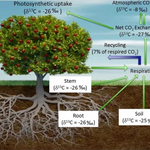
Photosynthesis and respiration of CO, by forests are two major unknowns in the global carbon cycle. They are the two largest and most variable fluxes, and their difference currently acts as a global net sink. With this project (2017-2020) we aim to provide new insights in the forest carbon balance by separately quantifying photosynthesis and respiration using atmospheric measurements. The…
Oxygen is a major and vital component of the Earth atmosphere representing about 21% of its oomposition. It is consumed or produced through biochemical processes such as oombustion, respiration, and photosynthesis. Although atmospheric oxygen is not a greenhouse gas, It can be used as a top down constraint on the carbon cycle.The variation observations of oxygen in the atmosphere are…
Particulate matter affects more people than any other ambient air pollutant, leading to increased risk of cardiovascular and respiratory diseases. Levels of PM10 and PM2.5 in the developing world, especially southeast Asia and the Indian subcontinent, routinely exceed World Health Organization guidelines, often by a factor of 10 or more. Despite their importance to poor air…
Photosynthesis is a complex process that consumes carbon dioxide and water to produce oxygen and glucose. Studies to investigate leaf-level photosynthetic activity have been conducted using systems that control certain parameters such as light intensity or partial pressure of CO2. For instance, the LI-COR LI‑6800 Portable Photosynthesis System enables the user to control and measure light,…
• The air quality inside vehicles is affected by the intake of polluted air and by outgassing of fabrics.
• Airlabs developed a portable air cleaner, the airbubbl, to remove particulate matter, NO2 and other pollutants from air. A new filter was designed to also remove formaldehyde.
• Here, we present the performance of the new formaldehyde filter, also in…
Atmospheric concentrations of N2O, CO2and CH4 are currently steadily increasing, and in the case of N2O, the increase in emissions is mainly linked to the increased use of fertilizers in agricultural soils. Stable isotope analysis of these trace gases is a valuable tool to better understand production and consumption pathways in soils and this…
Differentiating microbial, anthropogenic, and thermogenic sources of carbon dioxide (CO2) and methane (CH4) in background air is an important element of understanding
upper ocean ecosystem processes. Here we present isotopic data of carbon dioxide and methane from the Fleur de Passion sailing research vessel which traveled from Dakar (Senegal) to Carbo Verde, the…
Oxygen (18O/16O) and deuterium (D/H) isotopes are a widespread tool to trace physical and chemical processes in hydrology and biogeosciences. Precision and throughput are key parameters for water isotope analysis. Here, we will present two new methodologies for the Picarro L2130-i Cavity Ring-Down Spectroscopy (CRDS) water isotope analyzer that allow the user…
Atmospheric oxidation is dominated by the OH radical, although Cl atoms can play an important role under certain conditions. Gas-phase inorganic chlorine (Cly) controls the Cl budget. HCl dominates Cly[1]. Atmospheric sources and levels of HCl are poorly constrained. HCl is a sticky gas and is a challenge to measure with high time resolution. Most…
With the publication of the US EPA’s amendments to the Ethylene Oxide (EtO, EO) NESHAP rules impacting commercial sterilizers and chemical companies, many are wondering how to maintain operational continuity in light of new monitoring requirements. Timeline of compliance,…