 English
 简体中文
简体中文
 Deutsch

Measures NH3
 Powered by Bioz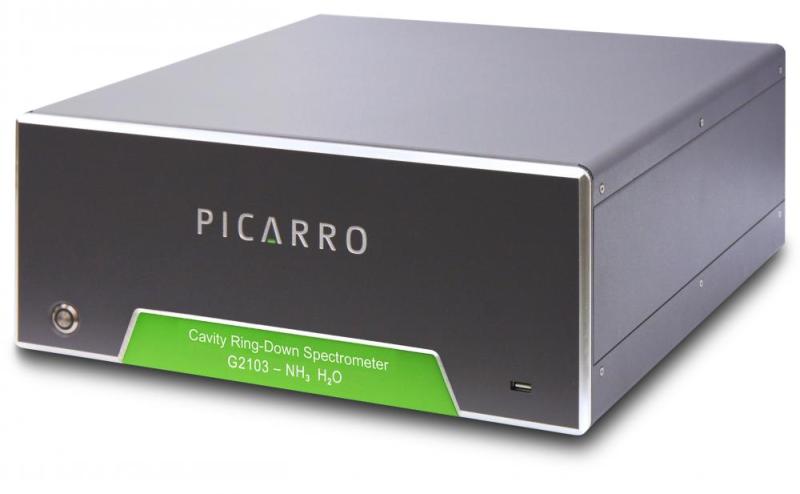
This product has been discontinued. Please refer to our Discontinued Products for information or check out the new PI2103 replacement analyzer.
The Picarro G2103 gas concentration analyzer provides precise, real-time measurement of ammonia (NH3) and water (H2O) vapor. It incorporates coated components in the critical gas pathway. This reduces the propensity of NH3 molecules to adhere to pathway surfaces, which improves measurement response time. The analyzer is an ideal solution for sensitive trace and ambient ammonia research and monitoring applications, such as livestock emissions on farms and formation of particle matters from ammonia in urban areas.
- Fast, continuous, real-time measurement of NH3
- Long-term stability for infrequent calibration
- Small footprint, field or lab deployable with no consumables required
- Water correction automatically reports dry gas mole fractions
Precision at 1 second, 10 seconds, and 5 minutes is 500, 170, and 30 and parts-per-trillion (ppt). Rise time (10 – 90%) and fall time (90 – 10%) is less than 2 minutes for 20 parts-per-billion (ppb) NH3 challenge. Drift at standard temperature and pressure (STP) over 72 hours is ± 0.15 ppb. Water correction software automatically reports dry gas mole fractions to help reduce research complexity and consumable costs.