 English
 简体中文
简体中文
 Deutsch


Magdalena Hofmann
Sr. Application Scientist at Picarro
Picarro Spotlight is a blog series showcasing important scientific work from our customers around the world. Each blog is selected and summarized by our team. Enjoy!
Reducing ammonia (NH₃) emissions is one of agriculture’s most urgent environmental challenges. Ammonia losses impact air quality, reduce nitrogen efficiency, and increasingly shape regulatory and sustainability expectations worldwide. Yet for decades, one fundamental problem slowed progress: measuring emissions accurately under real farming conditions.
Research led by Johanna Pedersen at Aarhus University is helping change that — demonstrating how high-precision measurement technology can transform ammonia research from uncertainty into actionable insight.
Across two recent peer-reviewed studies, Pedersen and collaborators show how trusted, high-resolution data enables scientists not only to measure emissions reliably, but also to evaluate which mitigation strategies actually work in the field.
Building Confidence in Real-World Measurements
In her 2024 paper, Evaluation of Optimized Flux Chamber Design for Measurement of Ammonia Emission After Field Application of Slurry with Full-Scale Farm Machinery, Pedersen addressed a long-standing challenge in agricultural emissions science: scaling measurements beyond small experimental plots.
Traditional approaches often struggled to represent real farm operations, where machinery size, soil variability, and environmental conditions introduce complexity. Without reliable field-scale measurements, comparing mitigation strategies remained uncertain.
The research team developed an optimized dynamic flux chamber system capable of operating alongside commercial slurry application equipment. Critically, the chambers were paired with Picarro’s cavity ring-down spectroscopy (CRDS) G2103 (now PI2103) Ammonia Analyzer for continuous, high-time-resolution ammonia monitoring.
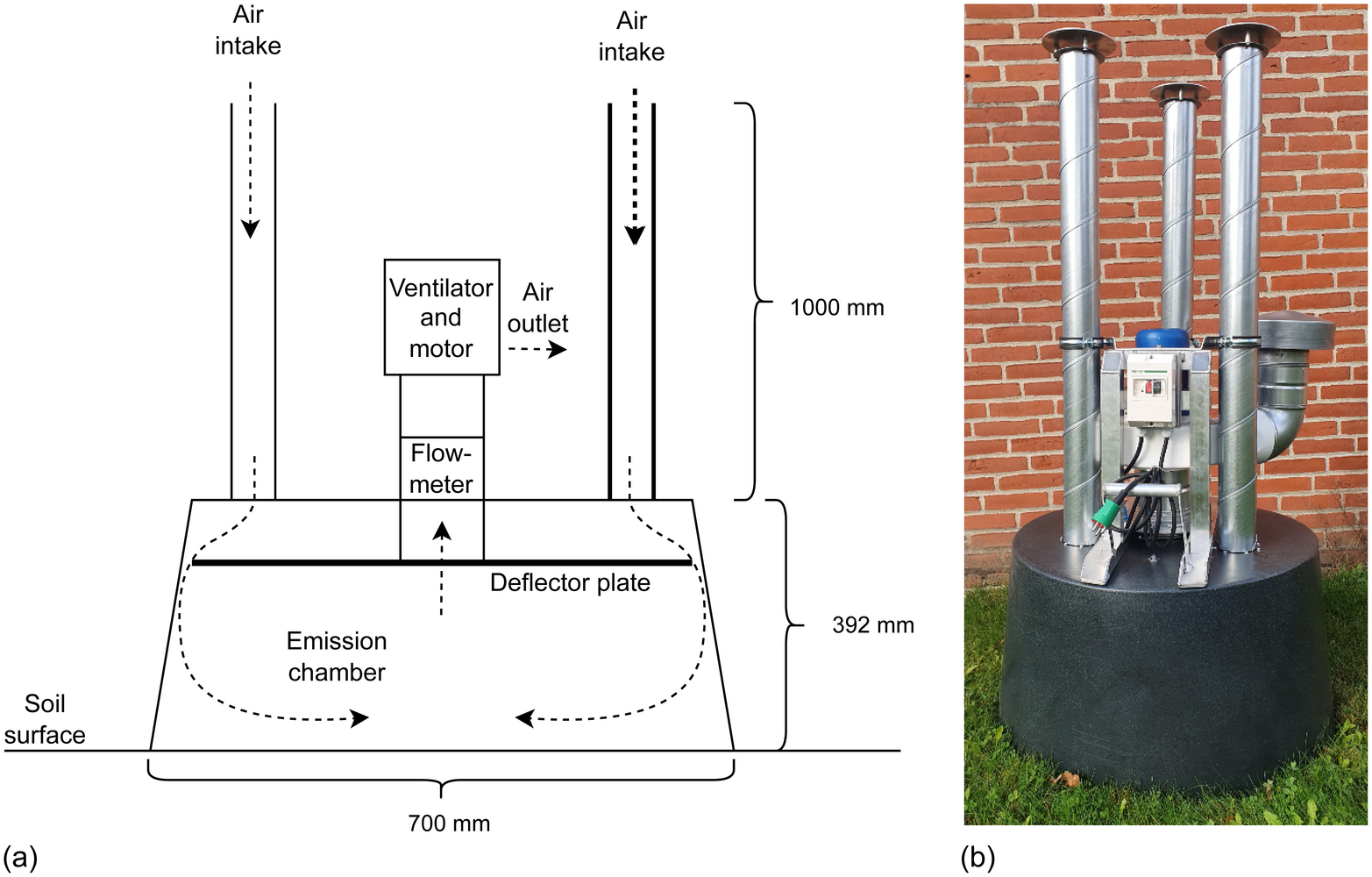
Figure 1(a) Sketch of the dynamic flux chamber (not to scale). (b) Picture of dynamic flux chamber. The reader is also referred to Fig. S1 in the Supplement for more information.
The results demonstrated precise, reproducible measurements across manual applications, experimental setups, and full-scale machinery. The system enabled replicated emission measurements with relatively high precision — a key requirement for evaluating mitigation approaches with confidence.
This work established something agriculture has long needed: a measurement framework capable of delivering laboratory-grade accuracy under real farming conditions.
From Measuring Emissions to Evaluating Solutions
With a validated measurement approach in place, Pedersen’s 2026 study — Assessment of Ammonia Emission Mitigation Efficiency of Established and Novel Field Application Techniques for Anaerobically Digested Slurry — moved the research forward.
As anaerobic digestion expands globally, digestate is increasingly used as fertilizer. However, its chemical properties can increase ammonia emission risk, creating new uncertainty around best application practices.
Using dynamic flux chambers combined with Picarro CRDS ammonia analyzers, the team conducted 12 field trials comparing slurry treatments and application techniques. The high temporal resolution allowed researchers to track emission behavior immediately after spreading when the majority of ammonia loss occurs.
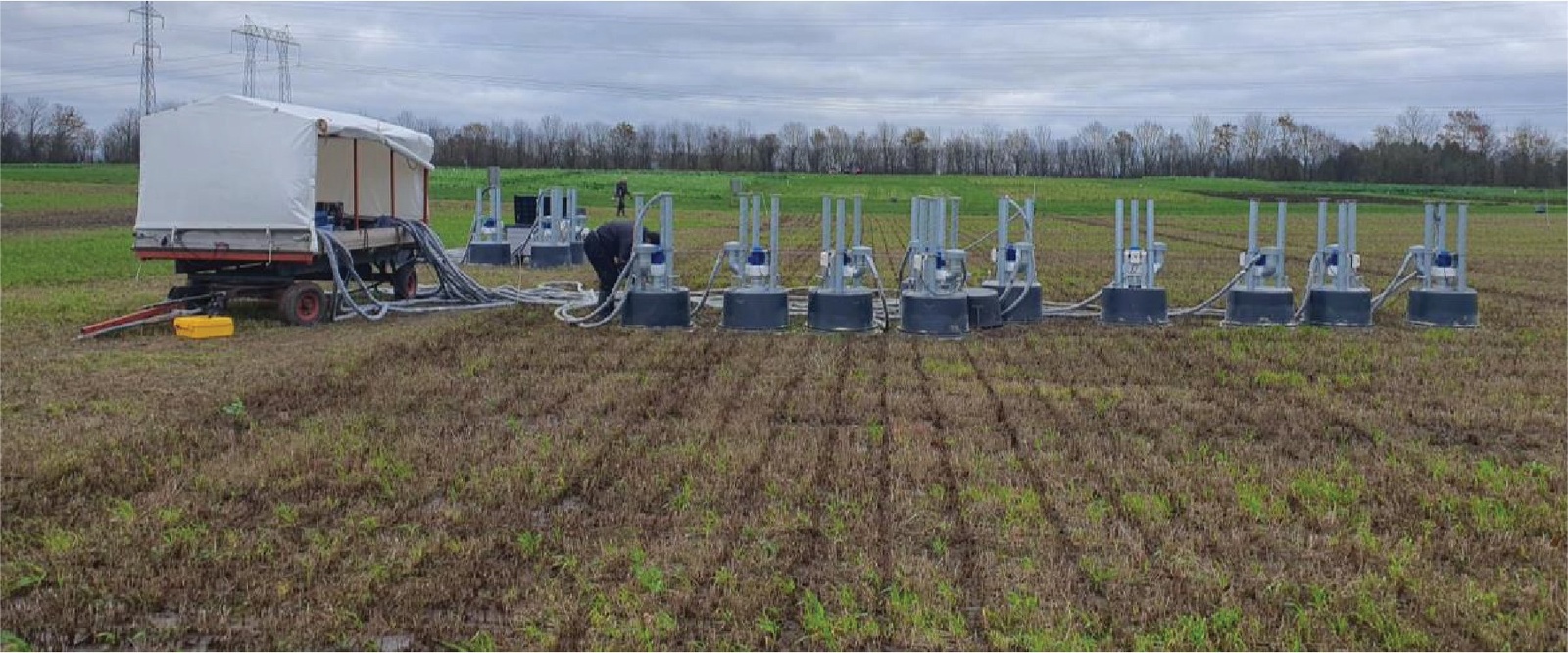
Figure 2 Aarhus University Field Trial using Picarro G2103 in Dynamic Flux Chambers
The findings revealed an important reality: mitigation effectiveness depends strongly on digestate properties and application methods. For example, separating slurry into liquid fractions reduced emissions by 33–83%, while a modified trailing shoe with a harrowing tine significantly lowered emissions compared with standard band application.
Perhaps most importantly, the study showed that no single universal solution exists. Reliable decisions require accurate measurement under real conditions reinforcing the importance of trusted data.
Why Trusted Data Changes the Conversation
Together, these studies represent a shift in agricultural emissions research.
Ammonia emissions are highly dynamic, often peaking within hours after application and responding rapidly to environmental and operational variables. Low-frequency or indirect measurements can miss critical emission events, leading to inconsistent conclusions.
By combining robust field sampling with high-precision CRDS gas analysis, Pedersen’s work demonstrates how continuous, real-time monitoring captures emission dynamics that were previously invisible. The result is clearer insight into when emissions occur, why they vary, and which mitigation strategies truly deliver results.
For researchers, this enables stronger experimental design and reproducible comparisons.
For agronomists and farmers, it supports improved nitrogen efficiency and more informed operational decisions.
For policymakers, it provides credible evidence to guide environmental regulation and reporting frameworks.
A Blueprint for the Future of Agricultural Emissions Monitoring
Pedersen’s research highlights a broader trend across environmental science: progress depends on measurement confidence.
As agriculture works to balance productivity with environmental stewardship, the ability to generate trusted emissions data at operational scale becomes essential. High-precision analyzers based on CRDS technology provide the sensitivity, stability, and time resolution needed to move beyond estimates toward direct observation.
In other words, mitigation begins with measurement.
By turning advanced ammonia monitoring into a practical field tool, this work provides a blueprint for how science, technology, and agriculture can work together — transforming uncertainty into actionable insight and helping build a more sustainable future grounded in trusted data.
For More Information
Read Pedersen et al. in Atmospheric Measurement Techniques
Read Pedersen et al. in Atmospheric Environment: X
Explore Research Center
Learn more about Picarro PI2103 Ammonia Analyzer